
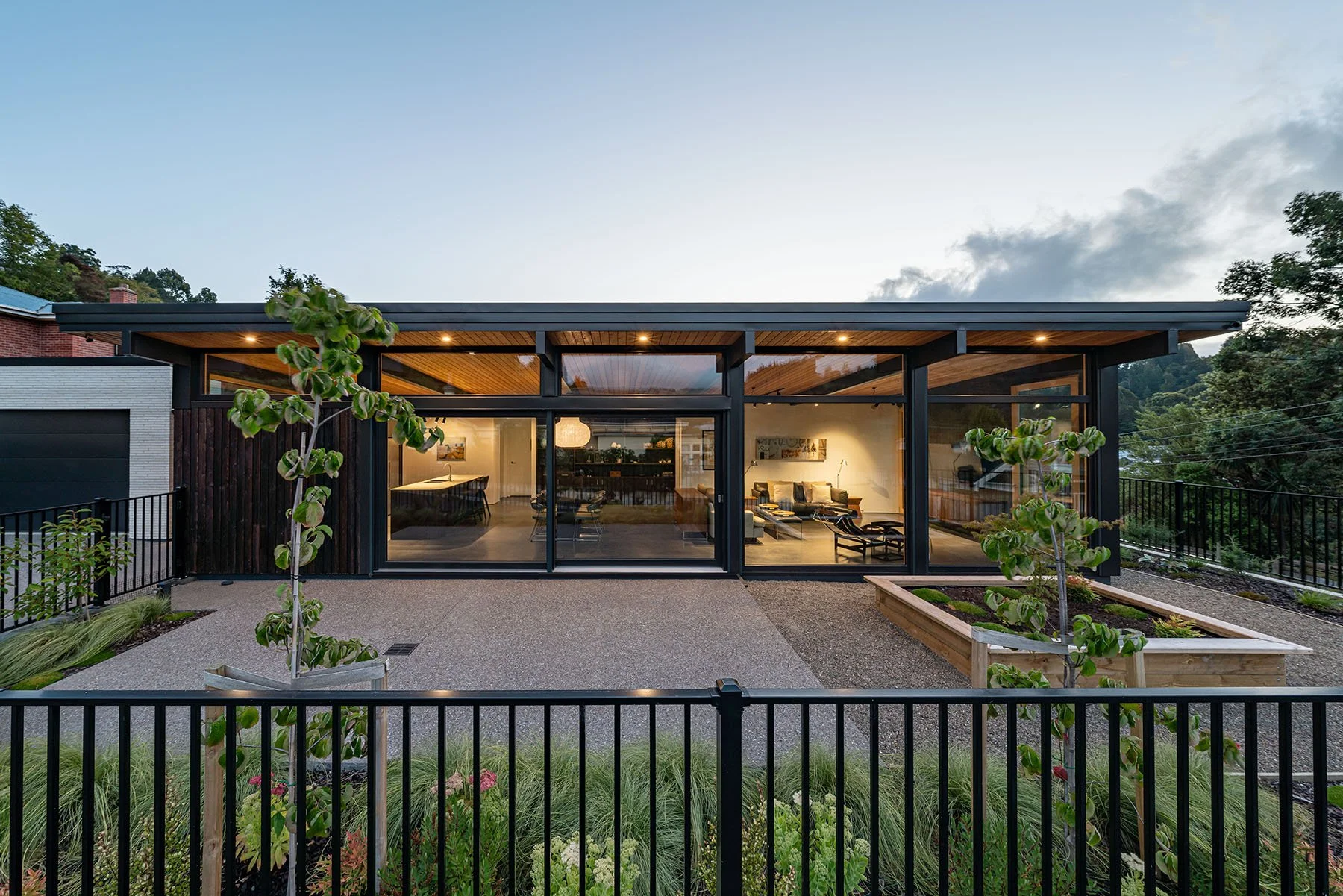
Midway House

Located on an elevated corner site in Dunedin's Northeast Valley Midway house is an exercise in managing the competing demands of privacy, outlook and solar access on a compact suburban site. Comprised of two contrasting building volumes, the project uses level changes and active external screens to mediate privacy and sunlight.
Our clients purchased a compact, slightly elevated corner site in Dunedin's Northeast Valley with the intention of building a home for their retirement. The northeast and northwest boundaries of the site are bounded by quite suburban streets. Views of Mt Cargill and surrounding hills were available to the north across the intersection.
The brief for this project called for a single-level 3-bedroom home with a double garage, workshop space and an open light filled living space. The brief also called for passive house certification.
From a planning point of view the site was challenging. 4.5m street setbacks and 2m side yards left a building platform of around 200m2 which was insufficient to enough to accommodate the project programme.
Our response was to locate the garage and workshop space at the southern end of the site, (level with the street), and extend the existing building platform northward using a new retaining wall to accommodate the house. In time, planting will grow and cover the retaining wall.
The thermal envelop of the home is a simple rectangle with a highly glazed living space facing northeast and northwest. A home office, guest room and service spaces are organised along the southwestern side of the building with the master bedroom facing northwest.
The level change is an essential element in mediating the relationship between the street and the private home, as are the external fabric roller blinds which can be lowered over the floor to ceiling windows to provide privacy and sun protection.
Entry to the house is provided via a sheltered front door located between the white brick garage and the Shou Sugi Ban clad house. These external cladding materials are continued into the entry foyer space where guests are led down a short hallway into the main living space. Exposed timber beams and a larch ceiling nod to a mid-century design language.
The external walls of the home are constructed using Structural Insulated Panels, internal walls and roof are timber framed. Windows are spruce triple glazed European windows, and the floor is fully insulated.
-
Completion: 2026
Builder: Paul Grellet Builders
Engineer: Structural Engineering Design Solutions
Architecture & Energy Modelling: Architype
Photographer: Nick Beadle
-
Achieving the passive house standard was an explicit requirement of the client's design brief. To achieve this objective for a reasonable budget it was essential that the thermal envelope of the house be compact with good levels of north facing glazing. As the site was oriented northeast roof overhangs were not going to be effective at reducing solar gains for low morning and evening sun. Because of this, two different types of external shading were used to control solar gains. For the living area external roller blinds and for the master bedroom a sliding timber screen.
Embodied carbon: The build is predominately timber framed (one steel beam). Retaining walls changed to timber from concrete block due to cost and carbon considerations.
Heat pump for space heating
Heat pump water heater
PV array on the garage.